
In 1987, Attention Deficit Hyperactivity Disorder, also known as ADHD, was voted into existence by a show of hands of American Psychiatric Association (APA) members. This is consensus – IT IS NOT SCIENCE.
There are no laboratory tests to verify the presence or absence of ADHD.
 Imagine seeing the following in a child:
- failing to give close attention to detail, making careless errors in schoolwork
- failing to sustain attention in tasks or play activities
- often appears not to listen to what is being said to him or her
- often fails to follow through on instructions or to finish schoolwork
- often avoids or strongly dislikes tasks, such as homework, that require sustained mental effort
- is often unduly noisy in playing or has difficulty in engaging quietly in leisure activities
- often blurts out answers before questions have been completed
- often interrupts or intrudes on others (e.g. butts into other’s conversations or games)
Doesn’t this sound like normal childhood behaviour?
These are just a few of the diagnostic criteria listed for hyperkinetic disorder in the ICD-10 Classification of Mental and Behavioural Disorders published by the World Health Organization (WHO).
The diagnosis is so broad that nearly all children, and even adults, could fit the criteria. To compound the error, psychiatrists introduce the use of psychotropic (affecting mental activity, behaviour and perception) drugs as ‘treatment.’
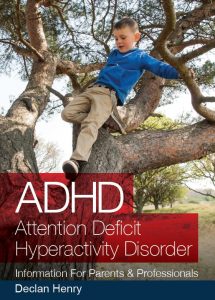 A booklet has been written by Declan Henry, a social worker with an interest in the welfare of young people. Titled Attention Deficit Hyperactivity Disorder: Information For Parents & Professionals, it examines the issue of problematic behaviour in young people and looks at the ever-increasing numbers who are diagnosed with ADHD.
Parents are rarely informed about the potential risks that go hand-in-hand with prescribed drugs. The psychiatric premise revolves around the idea of a ‘chemical imbalance’ in the brain, an idea that has been accepted without inspection. There are no scientific tests to determine the existence of such an imbalance just as there are no tests to determine if a chemical balance has been achieved.
Furthermore, the prescribed drugs can have serious consequences, that include some of the following side-effects:
- abdominal pain
- aggression
- depression
- dizziness
- drowsiness
- hallucinations
- headaches
- insomnia
- loss of appetite
- moodiness
- nervousness
- psychosis
- restlessness
- seizures
- stunted growth
- suicidal thoughts
- violent behaviour
- weight loss and ‘zombie’ appearance
Be fully informed so that you can make a fully informed choice for yourself, and if you’re a parent, for your children.
ADHD Drug Warnings & Studies
ADHD Drug Warnings:
There have been 60 warnings from nine countries (United States, United Kingdom, Canada, Japan, Australia, New Zealand, France, Denmark and Singapore) warning that ADHD drugs/stimulants cause harmful side effects. These include the following (note that some warnings cite more than one side effect, so the list below may not be equal to the total number of warnings):
- 26 warnings on stimulants causing cardiovascular problems
- 15 warnings on stimulants causing heart problems
- 10 warnings on stimulants causing mania or psychosis
- 9 warnings on stimulants causing death
- 9 warnings on stimulants causing violence, hostility or aggression
- 6 warnings on stimulants causing depression
- 5 warnings on stimulants causing agitation or irritability
- 5 warnings on stimulants causing suicide risk or attempts
- 4 warnings on stimulants causing hallucinations
- 4 warnings on stimulants causing anxiety
- 3 warnings on stimulants causing seizures or convulsions
- 3 warnings on stimulants causing addiction or dependence
ADHD Drug Studies
There are 32 studies from seven countries (United States, Australia, Denmark, Canada, South Korea, Colombia and Italy) showing that ADHD drugs/stimulants cause harmful side effects. These include the following (note that some studies cite more than one side effect, so the list below may not be equal to the total number of studies):
- 7 studies on stimulants causing heart problems
- 4 studies on stimulants showing lack of efficacy of the drug
- 4 studies on stimulants causing addiction/medication abuse
- 4 studies on stimulants causing stunted growth
- 2 studies on stimulants causing death
- 1 study on stimulants causing suicide risk/attempts
- 1 study on stimulants causing violence
- 1 study on stimulants causing homicidal ideation
- 1 study on stimulants causing irritability
- 1 study on stimulants causing mania, psychosis and hallucinations